Faculty and Custom Programs
Sample Programs
Thailand Experiences designs every faculty-led program around academic rigor, cultural depth, and real-world learning. We work closely with faculty to build customized itineraries that align with course objectives, embed structured reflection throughout, and connect students with Thai communities, professionals, and organizations in meaningful ways.
Our programs span disciplines from healthcare and social justice to creative industries and education. Below are three examples of programs we’ve delivered, highlighting what makes each one effective.
98% of students give us a Net Promoter Score of 8 or above. More than 90% of students report experiencing life-changing personal growth. Student evaluations consistently point to personal development, cross-cultural competence, and career readiness as key outcomes
Allied Health and Global Healthcare
Program Focus: Comparative healthcare systems, clinical observation, rehabilitation, traditional medicine, and global health equity
Program Overview
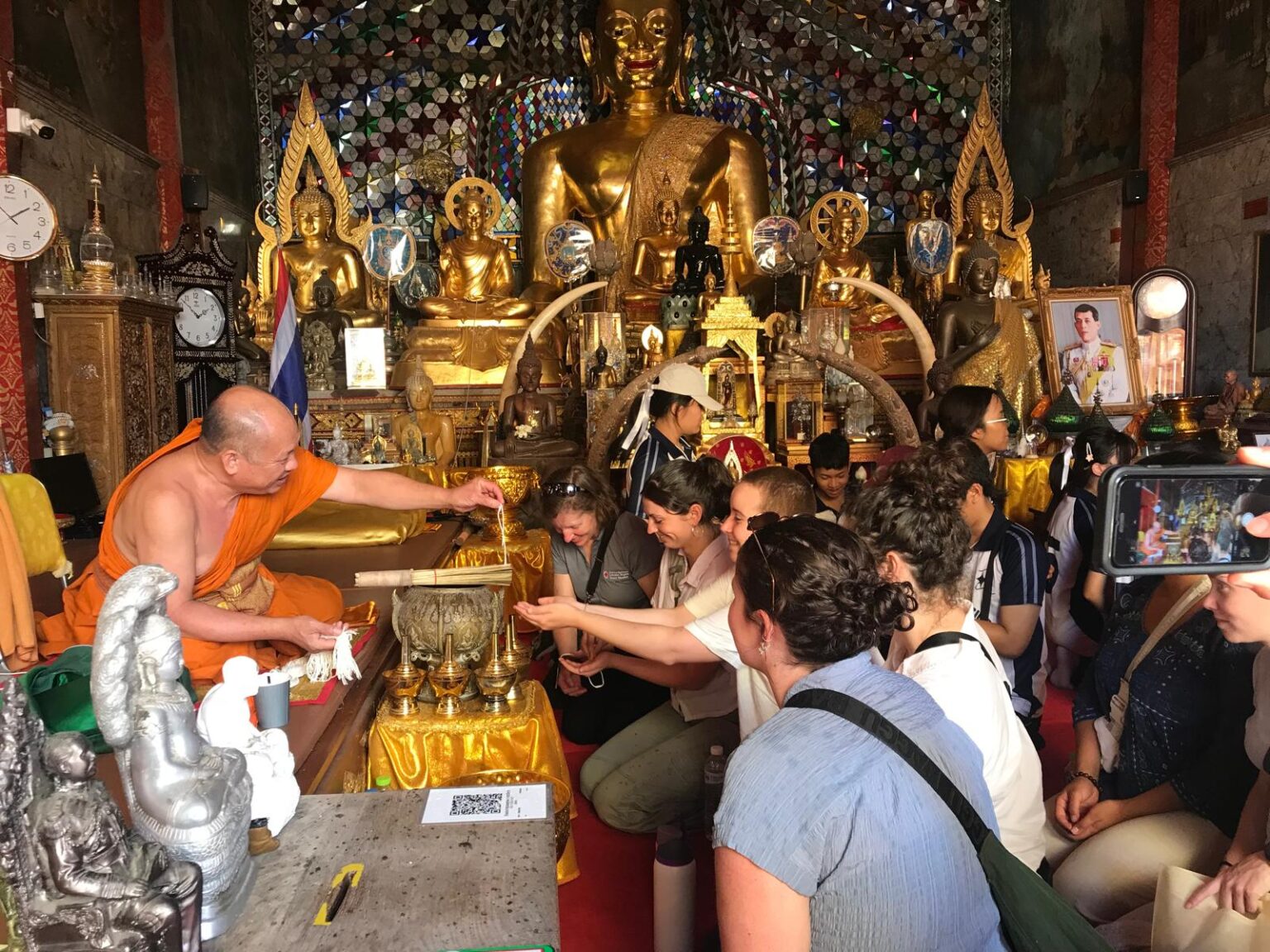
Our Allied Health programs take students into the heart of Thailand’s healthcare system — and often extend into Vietnam for a comparative perspective. Students visit public hospitals, rehabilitation departments, community health clinics, and NGO-led wellness initiatives. They observe how culture shapes patient care, compare Western and Eastern medical approaches, and explore traditional Thai and Vietnamese medicine practices firsthand.
Programs typically run 10–14 days and include site visits to Thai public health clinics (which combine Western and traditional medicine), hospital rehabilitation departments, physical therapy facilities, elder care centers, and public health NGOs. Cultural experiences like ethical elephant sanctuary visits, Thai cooking classes, and temple tours are woven throughout to deepen cultural understanding.
Academic Outcomes
- Students develop cross-cultural clinical awareness by comparing healthcare delivery models across Thai public hospitals, private facilities, and community clinics
- Structured reflection sessions connect field observations to coursework on healthcare systems, patient communication, and global health equity
- Programs align with NACE career competencies including critical thinking, global/intercultural fluency, and professionalism
- Students explore traditional medicine practices (Chinese medicine, Thai massage therapy, herbal treatments) alongside Western approaches
- Faculty-designed classroom sessions complement site visits with lectures and group analysis
Staffing and Support
Every healthcare program includes dedicated Thai program coordinators with deep knowledge of the local healthcare landscape, who are also professional interpreters who facilitate meaningful exchanges with Thai medical professionals. Our coordinators handle all logistics — from hospital access and transportation to dietary accommodations — so faculty can focus entirely on teaching.
What Students Say
“Thailand Experiences changed my career path. I went into international healthcare because of what I learned there — not just about medicine, but about how culture shapes health.” Nursing Student, UMass
“The structured reflection sessions made all the difference. Without them, I would have just been confused by cultural differences instead of learning from them.” Healthcare Student, Indiana University
“This was the trip of a lifetime and I am so grateful that I had the opportunity to go on it!” Tampa Global Health Student
“Two years later, I still use the frameworks I learned in Thailand. Understanding indirect communication and saving face has made me a better therapist, even with American clients.” Occupational Therapy Graduate, Daemen University
Fashion Industry and Creative Arts
Program Focus: Thailand’s textile heritage, contemporary fashion industry, sustainable design, and creative entrepreneurship in Southeast Asia
Program Overview
Thailand is one of Asia’s most dynamic fashion and textile hubs, with a rich tradition stretching from hand-woven silk in the northeast (Isaan) to Bangkok’s thriving contemporary design scene. Our Fashion Industry programs immerse students in this creative ecosystem — from visiting silk-weaving villages and learning traditional dyeing techniques to meeting Bangkok-based designers, visiting garment production facilities, and exploring the intersection of sustainability and fashion in a developing economy.
Students examine every stage of the supply chain: raw material production in rural communities, artisan workshops, manufacturing operations, retail environments, and the growing sustainable fashion movement in Southeast Asia. The program connects creative practice with business strategy, ethics, and cross-cultural communication.
Academic Outcomes
- Students gain hands-on exposure to global supply chains from raw materials to finished garments, understanding the social and economic context at each stage
- Visits to artisan communities in Chiang Mai and Isaan build awareness of ethical sourcing, fair trade practices, and the tension between tradition and commercial scale
- Students analyze how Thai cultural values (community, craftsmanship, sustainability) shape creative industries differently from Western models
- Workshops and studio visits with Thai designers develop cross-cultural creative collaboration skills and expose students to non-Western design aesthetics
- Structured reflection connects observations to coursework on global fashion systems, sustainable business models, and cultural identity in design
Staffing and Support
Programs include coordinators fluent in both Thai creative industry networks and the academic expectations of international fashion programs. Our team arranges access to studios, workshops, and production facilities that are not available through standard tourism channels, and provides cultural interpretation that helps students understand the business relationships and values behind what they observe.
What Students Say
“Seeing how Thai silk is made from start to finish from the silkworm farms to the hand looms completely changed how I think about materials and labor in fashion.” Fashion Design Student, Columbia College
“I expected to learn about textiles, but I came away understanding how an entire creative economy works differently when community values come first.” Australian Creative Arts Student
“The visits to Chiang Mai artisan workshops were incredible. These aren’t tourist experiences — they’re real production spaces where families have been weaving for generations.” Fashion Industry Student
Anti-Trafficking and Social Justice
Program Focus: Human trafficking awareness, social justice systems, NGO operations, community-based intervention, social work and cross-cultural approaches to advocacy
Program Overview
Thailand sits at the intersection of complex regional migration patterns and has developed sophisticated — if imperfect — systems for addressing human trafficking and exploitation. Our Anti-Trafficking programs take students deep into this landscape, connecting them with Thai NGOs, government agencies, community organizations, and frontline advocates who are working on prevention, intervention, and survivor support.
Students visit shelters and rehabilitation centers, meet with anti-trafficking NGO leadership, observe community-based prevention programs, and learn how Thai legal and social systems approach trafficking differently from Western models. The program emphasizes understanding root causes — poverty, migration, cultural factors — alongside the response systems, and challenges students to examine their own assumptions about justice, advocacy, and international development.
Academic Outcomes
- Students develop a nuanced, systems-level understanding of human trafficking that goes beyond awareness campaigns to examine root causes, cultural context, and institutional responses
- Direct engagement with Thai NGOs and advocates builds professional skills in cross-cultural advocacy, community development, and social justice practice
- Structured reflection sessions help students process emotionally challenging material and connect field experiences to academic frameworks in criminal justice, social work, and international development
- Students compare Thai and Western approaches to survivor support, legal prosecution, and community prevention, developing critical analysis skills
- Programs build NACE competencies in critical thinking, equity and inclusion, and professionalism through real-world application
Staffing and Support
These programs require especially sensitive coordination. Our Thai program coordinators have established relationships with trusted NGOs and community organizations, and provide essential cultural context that helps students understand indirect communication styles, hierarchical relationships, and the concept of “face” — all critical when engaging with sensitive social justice topics in a Thai context. We also provide thorough pre-visit briefings and post-visit debriefs to ensure students process what they’ve experienced.
What Students Say
“After returning home, I would describe my study abroad experience as life-changing… It was truly a great and impactful itinerary, thoughtfully planned out.” UCF Anti-Trafficking Student
“Thailand Experiences didn’t just show us Thailand — they helped us understand why things work the way they do. Learning about ‘face’ and ‘greang jai’ changed how I communicate with people from different cultures, even back home.” Education Student, UC Davis
“Our in-country coordinator understood both cultures so well. She could explain why things felt confusing and help us navigate situations we didn’t understand. She was a bridge between worlds.” Anti-Trafficking Program Student
“This wasn’t tourism disguised as education. This was real learning challenging, uncomfortable at times, and absolutely transformative.” Semester Student, Bangkok
Ready to Design Your Program?
We design faculty-led programs across virtually any discipline — from healthcare and social justice to business, education, STEM, and the creative arts. Every program is fully customized to your academic goals, student needs, and institutional requirements.
Let’s start the conversation
Our Team
Meet our team of Cross Cultural Experts

Ann Rungsinee
Bangkok Site Director
Ann has a background in social science and graduated with a master’s degree in international development from the U.K.

Adisorn Dechaboon
Chiang Mai Site Director
Adisorn is educated in languages and a fascination with culture exchange.

David Jackson
Director
For the last 20 years has lived and in Thailand, as a teacher, as a development officer in NGOs, and with volunteers and study abroad programs. He has an M.A. in Asia Pacific Studies, an M.B.A. and is fluent in Thai.

Thamonpat Cooperider
Program Manager
Thamonpat brings a wealth of non profit and management experience to Thailand Experiences.